Personal Information
Address: Department of Atmospheric and Oceanic Science
University of Maryland
College Park, Maryland 20742-2425
Tel. (301) 405-2018; Fax: (301) 314-9482
Email: dalin@atmos.umd.edu
Educational Background:
Professional Employment:
1996-Present: Associate & Full Professor, Department of Atmospheric and Oceanic Science, University of Maryland
Awards and Honors:
Refereed Publications (Google Scholar) :
1. Zhang, D. and R.A. Anthes, 1982: A high-resolution model of the planetary
boundary layer - Sensitivity tests and comparisons with SESAME-79 data.
Journal of Applied Meteorology, 21, 1594-1609. PDF
2. Zhang, D.-L., H.-R. Chang, N.L. Seaman, T.T. Warner and J.M. Fritsch, 1986:
A two-way interactive nesting procedure with variable terrain resolution. Monthly Weather Review,
114, 1330-1339. PDF
3. Zhang, D.-L., and J.M. Fritsch, 1986: Numerical simulation of the meso-beta-scale
structure and evolution of the 1977 Johnstown flood. Part I: Model description and
verification. Journal of the Atmospheric Sciences, 43, 1913-1943. PDF
4. Zhang, D.-L., and J.M. Fritsch, 1986: A case study of the sensitivity of numerical
simulation of mesoscale convective systems to varying initial conditions.
Monthly Weather Review, 114, 2418-2431. PDF
5. Zhang, D.-L., and J.M. Fritsch, 1987: Numerical simulation of the meso-beta-scale
structure and evolution of the 1977 Johnstown flood. Part II: Inertially stable
warm-core vortex and the mesoscale convective complex. Journal of the Atmospheric
Sciences, 44, 2593-2612. PDF
6. Zhang, D.-L., E.-Y. Hsie and M.W. Moncrieff, 1988: A comparison of explicit and
implicit predictions of convective and stratiform precipitating weather systems with
a meso-beta-scale numerical model. Quarterly Journal of the Royal Meteorological Society,
114, 31-60. PDF
7. Zhang, D.-L., and J.M. Fritsch, 1988: Numerical sensitivity experiments of varying
model physics on the structure, evolution and dynamics of two mesoscale convective
systems. Journal of the Atmospheric Sciences, 45, 261-293. PDF
8. Zhang, D.-L., and J.M. Fritsch, 1988: Numerical simulation of the meso-beta-scale
structure and evolution of the 1977 Johnstown flood. Part III: Internal gravity waves
and the squall line. Journal of the Atmospheric Sciences, 45, 1252-1268. PDF
9. Zhang, D.-L., and J.M. Fritsch, 1988: A numerical investigation of a convectively
generated, inertially stable, extratropical warm-core mesovortex over land. Part I:
Structure and evolution. Monthly Weather Review, 116, 2660-2687. PDF
10. Zhang, D.-L., K. Gao and D.B Parsons, 1989: Numerical simulation of an intense squall
line during 10 - 11 June 1985 PRE-STORM. Part I: Model verification. Monthly Weather Review,
117, 960-994. PDF
11. Zhang, D.-L., and K. Gao, 1989: Numerical simulation of an intense squall line during
10 - 11 June 1985 PRE-STORM. Part II: Rear inflow, surface pressure perturbations and
stratiform precipitation. Monthly Weather Review, 117, 2067-2094. PDF
12.(a) Zhang, D.-L., 1989: The effect of parameterized ice microphysics on the simulation
of vortex circulation with a mesoscale hydrostatic model. Tellus, 41A, 132-147. PDF
13. Gao, K., D.-L. Zhang, M.W. Moncrieff and H.-R. Cho, 1990: Mesoscale momentum budget
in a midlatitude squall line: A numerical case study. Monthly Weather Review,
118, 1011-1028. PDF
14. Zhang, D.-L., and H.-R. Cho, 1992: The development of negative moist potential
vorticity in the stratiform region of a simulated squall line. Monthly Weather Review,
120, 1322-1341. PDF
15. Zhang, D.-L., 1992: The formation of a cooling-induced mesovortex in the trailing
stratiform region of a midlatitude squall line. Monthly Weather Review, 120, 2763-2785. PDF
16. Zhang, D.-L., 1992: Numerical simulation of the internal structure of a mesoscale convective system. In the book: East Asia & West Pacific Meteorology & Climate (II), Edited by W.J. Kyle and C.P. Chang, World Scientific, 421-428.
17. Zhang, D.-L., and Z. Wang, 1993: A meso-beta-scale kinetic energy analysis of
a midlatitude squall system. Journal of the Meteorological Society of Japan, 71, 469-490. PDF
18. Zhang, D.-L., 1993: The development of mesovortices in the stratiform region of a midlatitude squall line. In the book: Climate, Environment & Geophysical Fluid Dynamics, Edited by D. Ye, Q. Zeng, G. Wu & Z. Zhang, China Meteorological Press, 239-253.
19. Kelly, R., J. Gyakum, D.-L. Zhang and P.J. Roebber, 1994: A diagnostic
study of the early phases of sixteen north-Pacific cyclones.
Journal of the Meteorological Society of Japan, 72, 515-530. PDF
20. Gao, K., and D.-L. Zhang, 1994: The roles of diabatic model physics
in the meso-beta-scale simulation of a midlatitude squall line. Acta Meteorologica Sinica
(in Chinese), 52, 321-331.
21. Zhang, D.-L., J.S. Kain, J.M. Fritsch and K. Gao, 1994: Comments on:
"Parameterization of convective precipitation in mesoscale numerical models:
A critical review." Monthly Weather Review, 122, 2222-2231. PDF
Reply of J. Molinari and M. Dudek PDF .
22. Blair, S., D.-L. Zhang and J. Mailhot, 1994: Numerical prediction of the 10-11 June
1985 squall line with the Canadian Regional Finite-Element model. Weather and Forecasting,
9, 157-172. PDF
23. Blair, S., D.-L. Zhang and J. Mailhot, 1995: Numerical simulation of an
intense convective system associated with the July 1987 Montreal flood.
Part I: Gravity waves and the squall line. Atmosphere - Ocean, 33,
447-473. PDF.
24. Blair, S., D.-L. Zhang and J. Mailhot, 1995: Numerical simulation of an
intense convective system associated with the July 1987 Montreal flood. Part II: A
trailing stratiform rainband.
Atmosphere - Ocean, 33, 475-500. PDF.
25. Huo, Z., D.-L. Zhang, J. Gyakum and A. Staniforth, 1995: A diagnostic
analysis of the superstorm of March 1993. Monthly Weather Review, 123,
1740-1761. PDF
26. Zhang, D.-L., and R. Harvey, 1995: Enhancement of extratropical cyclogenesis
by a mesoscale convective system. Journal of the Atmospheric Sciences,
52, 1107-1127. PDF
27. Zhang, D.-L., and H.-R. Cho, 1995: Three-dimensional simulation of frontal
rainbands and conditional symmetric instability in the Eady-wave model.
Tellus, 47A, 45-61. PDF
28. Gyakum, J.R., M. Carrera, D.-L. Zhang, S. Miller, J. Caveen, R. Benoit, T. Black, A. Buzzi, C. Chouinard, M. Fantini, C. Folloni, J.J. Katzfey, Y.-H. Kuo, F. O. Lalaurette, S. Low-Nam, J. Mailhot, P. Malguzzi, J.L. McGregor, M. Nakamura, G. Tripoli and C. Wilson, 1996: A regional model
intercomparison using a case of explosive oceanic cyclogenesis. Weather and Forecasting,
11, 521-543. PDF
29. Zhang, D.-L. and N. Bao, 1996: Oceanic cyclogenesis as induced by a
mesoscale convective system moving offshore. Part I: A 90-h real-data
simulation. Monthly Weather Review, 124, 1449-1469. PDF
30. Zhang, D.-L. and N. Bao, 1996: Oceanic cyclogenesis as induced by a
mesoscale convective system moving offshore. Part II: Genesis and
thermodynamic transformation. Monthly Weather Review, 124, 2206-2225. PDF
31. Gyakum, J., D.-L. Zhang, J. Witte, K. Thomas and W. Wintels, 1996:
CASP II and Canadian cyclones during the 1989-92 cold seasons. Atmosphere - Ocean,
34, 1-16. PDF.
32. Huo, Z., D.-L. Zhang and J. Gyakum, 1996: The life cycle of the intense
IOP-14 storm during CASP II. Part I: Analysis and simulations. Atmosphere - Ocean,
34, 51-80. PDF.
33. Huo, Z., D.-L. Zhang and J. Gyakum, 1996: The life cycle of the intense
IOP-14 storm during CASP II. Part II: Sensitivity experiments. Atmosphere -
Ocean, 34, 81-102. PDF.
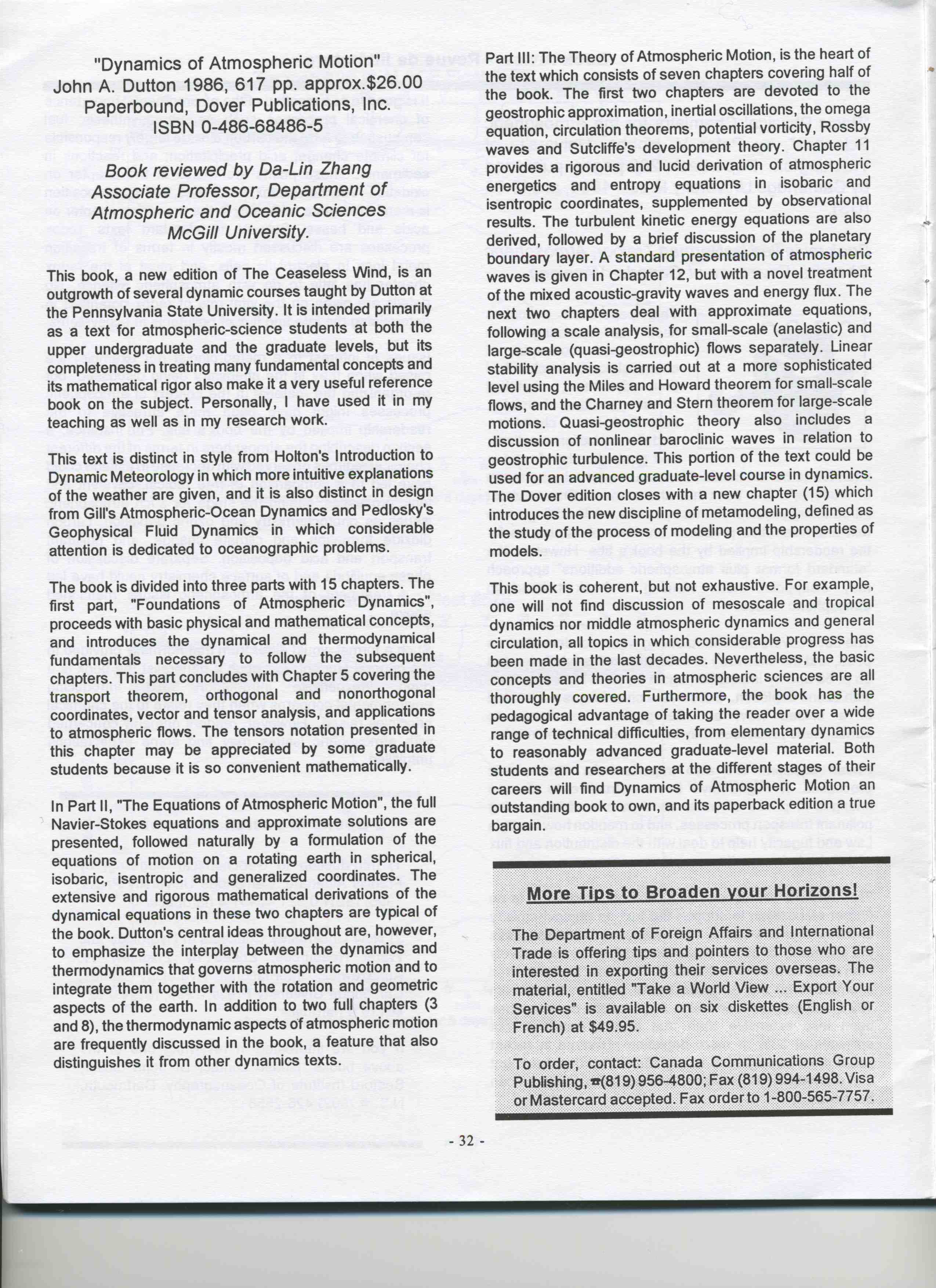
34. Zhang, D.-L., 1996: Book Review: "Dynamics of Atmospheric Motion (Dover Publications, Inc., 617pp)"
by John A. Dutton, Bulletin of the Canadian Meteorological & Oceanic Society, 24, pg. 32.
35. Liu, Y., D.-L. Zhang and M.K. Yau, 1997: A multiscale numerical study of
Hurricane Andrew (1992). Part I: Explicit simulation
and verification. Monthly Weather Review, 125, 3073-3093. PDF
36. Zhang, D.-L. and K. MacGillivray, 1997: A numerical investigation of a moderate
coastal storm with intense precipitation. Atmosphere-Ocean, 35, 161-187. PDF.
37. Blair, S. and D.-L. Zhang, 1997: A numerical study of the along-line
variability of a frontal squall line during PRE-STORM. Monthly Weather Review,
125, 2544-2561. PDF
38. Kuo, Y.-H., J. Bresch, M.-D. Cheng, J. Kain, D.B. Parsons, W.-K. Tao and
D.-L. Zhang, 1997: Summary of a mini-workshop on cumulus parameterization
for mesoscale models. Bulletin of the American Meteorological Society, 78, 475-491.
39. (a) Zhang, D.-L., 1998: Roles of various diabatic physical processes in mesoscale models (in Chinese).
Scientia Atmospherica Sinica, 22, 548-561.
40. Huo, Z., D.-L. Zhang, and J. Gyakum, 1998: An application of potential vorticity
inversion to improving the numerical prediction of the
March 1993 superstorm. Monthly Weather Review, 126, 424-436. PDF
41. Carrera, M., J. R. Gyakum and D. -L. Zhang, 1999: A numerical sensitivity study of secondary
marine cyclogenesis to initial error and varying physical processes. Monthly
Weather Review , 127, 641-660. PDF
42. Zhang, D.-L., Y. Liu and M.K. Yau, 1999: Surface winds at landfall of Hurricane Andrew
(1992) - A reply. PDF To the Comments of M. Powell and S. Houston PDF . Monthly Weather Review, 127, 1711-1721.
43. Zhang, D.-L., E. N. Radeva and J. Gyakum, 1999: A family of frontal cyclones over the Western
Atlantic ocean. Part I: A 60-h simulation. Monthly Weather Review, 127, 1725-1744. PDF
44. Zhang, D.-L., E. N. Radeva and J. Gyakum, 1999: A family of frontal cyclones over the Western
Atlantic ocean. Part II: Parameter studies. Monthly Weather Review , 127, 1745-1760. PDF
45. Huo, Z., D.-L. Zhang and J. Gyakum 1999: The interaction of potential vorticity
anomalies in extratropical cyclogenesis. Part I: Static piecewise inversion.
Monthly Weather Review, 127, 2546-2561. PDF
46. Huo, Z.-H., D.-L. Zhang and J. Gyakum 1999: The interaction of potential vorticity
anomalies in extratropical cyclogenesis. Part II: Sensitivity to initial perturbations.
Monthly Weather Review, 127, 2563-2575. PDF
47. Liu, Y., D.-L. Zhang and M.K. Yau, 1999: A multiscale numerical study of
Hurricane Andrew (1992). Part II: Kinematics and
inner-core structures. Monthly Weather Review, 127,
2597-2616. PDF
48. Zhang, D.-L. and E. Altshuler, 1999: The effects of dissipative heating on hurricane intensity.
Monthly Weather Review, 127, 3032-3038. PDF
49. Wang, J., and D.-L. Zhang, 2000: A numerical case study of frontal cyclogenesis over the
east coast of North America. Acta Meteorologica Sinica, 14 , 173-192.
50. Zhang, D.-L., Y. Liu and M.K. Yau, 2000: A multiscale numerical study of Hurricane
Andrew (1992). Part III: Dynamically-induced vertical motion.
Monthly Weather Review, 128, 3772-3788. PDF
51. Zhang, D.-L., Y. Liu and M.K. Yau, 2001: A multiscale numerical study of Hurricane
Andrew (1992). Part IV: Unbalanced flows. Monthly Weather Review, 129, 92-107. PDF
52. Nagarajan, B., M.K. Yau and D.-L. Zhang, 2001: A numerical study of a mesoscale
convective system during TOGA COARE. Part I: Model description and verification.
Monthly Weather Review, 129, 2501-2520. PDF
53. Zhang, D.-L., 2001: Multiscale modeling of hurricanes: A review. In the book: Dynamics of Atmospheric-Oceanic Circulation and Climate (Invited), 727-744.
54.(a) Lu, H., Z. Ke and D.-L. Zhang, 2001: Mesoscale characteristics of Hurricane Andrew (1992)
(in Chinese). Scientia Atmospherica Sinica, 25,, 827-836.
55. Lu, H., Z. Ke and D.-L. Zhang, 2002: A possible developing mechanism of the slantwise updraft
in the eyewall of Hurricane Andrew (1992) - Nonlinear convective and symmetrical instability
(in Chinese). Scientia Atmospherica Sinica, 26, 83-90.
56. Zhang, D.-L., 2002: A personal perspective on the reform of
the Advances in Atmospheric
Sciences. Advances in Atmospheric Sciences, 19 , 757-764. PDF
57. Jin, M. and D.-L. Zhang, 2002: Observed variations of leaf area index and its relationship
with surface temperatures during warm seasons. Meteorology and Atmospheric Physics ,
80, 117-129. PDF
58. Zhu, T., D.-L. Zhang and F. Weng 2002: Impact of the Advanced Microwave Sounding Unit data
on hurricane prediction. Monthly Weather Review, 130, 2416-2432. PDF
59. Zhang, D.-L., W. Cheng and J. Gyakum 2002: The impact of various potential vorticity
anomalies on multiple frontal cyclogenesis events. Quarterly Journal of the Royal
Meteorological Society , 128, 1847-1878. PDF
60. Zhang, D.-L., Y. Liu and M.K. Yau, 2002: A multiscale numerical study of Hurricane Andrew (
1992). Part V: Inner-core thermodynamics. Monthly Weather Review , 130,
2745-2763. PDF
61. Zhang, D.-L., Y. Liu and M.K. Yau, 2002: On the formation of the hurricane eye. In Book Series on East Asia Meteorology, Vol. 1, Edited by C.P. Chang et al., World Scientific Publishing Company, 219-227.
62. Zhang, D.-L., W. Zheng and Y.-K. Xue, 2003: A numerical study of early summer regional climate and weather over
LSA-East. Part I: Model implementation and verification. Monthly
Weather Review , 131, 1895-1909. PDF
63. Wang, X. and D.-L. Zhang: 2003: Potential vorticity diagnosis of a simulated hurricane. Part I:
Formulation and quasi-balanced flow. Journal of the Atmospheric Sciences , 60,
1593-1607. PDF
64. Zhang, D.-L., and X. Wang, 2003: Dependence of hurricane intensity and structures on vertical resolution and time-step size. Advances in Atmospheric Sciences , 20,
711-725. PDF
65. Zhu, T., D.-L. Zhang and F. Weng, 2004: Numerical simulation of Hurricane Bonnie (1998).
Part I: Eyewall evolution and intensity changes. Monthly Weather
Review , 132, 225-241. PDF
66. Yau, M.K., Y. Liu, D.-L. Zhang, and Yongsheng Chen, 2004: A multiscale numerical
study of Hurricane Andrew (1992). Part VI: Small-scale inner-core structures and wind
streaks. Monthly Weather Review , 132, 1410-1433. PDF
67. Zhang, D.-L. and W.-Z. Zheng, 2004: Diurnal cycles of surface winds and temperatures
as simulated by five boundary-layer parameterizations. Journal of
Applied Meteorology, 43, 157-169. PDF
68. Nagarajan, B., M.K. Yau and D.-L. Zhang, 2004: A numerical study of a mesoscale
convective system during TOGA COARE. Part II: Organization. Monthly
Weather Review , 132,1000-1017. PDF
69. Zhang, D.-L., 2004: Emergency response and disaster mitigation: A review of the US Information Management architecture
(in Chinese). Natural Disaster Reduction in China, 52, 51-53.
70. Cao, Z., and D.-L. Zhang, 2004: Track surface cyclones with moist potential vorticity.
Advances in Atmospheric Sciences, 21, 830-835. PDF
71. Wu, G.-X., H. Wang, and D.-L. Zhang, 2004: Editorial statement- Action and policy.
Advances in Atmospheric Sciences, 21, 382. PDF
72. Jin, M., R.E. Dickinson and D.-L. Zhang, 2005: The footprint of urban areas on global
climate as characterized by MODIS. Journal of Climate, 18, 1551-1565. PDF
73. Zhang, D.-L., and J. Zhu, 2005: Editorial - A special issue for the Third International Ocean-Atmosphere Conference. Advances in Atmospheric Sciences, 22(6).
74. Zhang, D.-L., and C. Q. Kieu, 2005: Shear-forced vertical circulations in tropical cyclones.
Geophysical Research Letters, 32, L13822, doi:10.1029/2005GL023146. PDF
75. Zhang, D.-L., 2005: A review of centenary advances and prospects in atmospheric sciences (in Chinese).
Acta Meteorologica Sinica, 63, 812-824. PDF
76. Cao, Z., and D.-L. Zhang, 2005: Sensitivity of cyclone tracks to the initial moisture distribution:
A moist potential vorticity perspective. Advances in Atmospheric Sciences, 22, 807-820. PDF
77. Zhang, D.-L., and C. Q. Kieu, 2006: How tropical cyclones resist destruction from vertical shear. Conference Notebook, Bulletin of the American Meteorological Society, 87, 22-23.
78. Wu, G., H. Wang, and D.-L. Zhang, 2006: Editorial statement. Advances in Atmospheric Sciences, 23, 542.
79. Zhu, T., and D.-L. Zhang, 2006: Numerical simulation of Hurricane Bonnie (1998).
Part II: Sensitivity to cloud microphysical processes. Journal of the Atmospheric Sciences, 63, 109-126. PDF
80. Zhang, D.-L., S. Zhang, and S. Weaver, 2006: Low-level jets over the Mid-Atlantic states: Warm-season climatology and a case study.
Journal of Applied Meteorology and Climatology, 45, 194-209. PDF
81. Zhu, T. and D.-L. Zhang, 2006: The impact of the storm-induced SST cooling on hurricane intensity.
Advances in Atmospheric Sciences, 23, 14-22. PDF
82. Li, M., L. Zhong, W. C. Boicourt, S. Zhang and D.-L. Zhang, 2006: Hurricane-induced storm surges,
currents and destratification in a semi-enclosed bay. Geophysical Research Letters, 33, L02604, doi:10.1029/2005GL024992. PDF
83. Liu, H., D.-L. Zhang, and B. Wang, 2006: Recent advances in regional climate modeling research and applications (in Chinese). Climatic and Environmental Research, 11, 649-668. PDF
84. Li, X., S. Zhang, and D.-L. Zhang, 2006: Thermodynamic, cloud microphysical, and rainfall responses to initial moisture
perturbations in the tropical deep convective regime. Journal of Geophysical Research: Atmospheres, 111, D14207, doi:10.1029/2005JD006968. PDF
85. Zhang, D.-L., and C. Q. Kieu, 2006: Potential vorticity diagnosis of a simulated hurricane. Part II: Quasi-balanced
contributions to forced secondary circulations. Journal of the Atmospheric Sciences, 63, 2898-2914. PDF
86. Li, Z. , L. Chiu, S. Weng, D.-L. Zhang, J. Du, J. Huang, M. Jin, H. Jung, F.-C. Ko, S. Lu, S. Yang, and D. Yuan, 2007:
The rapid growth of publications by atmospheric and oceanic scientists of Chinese origin. Bulletin of the American Meteorological Society, 88, 846-848. PDF
87. Halverson, J.B., M. Black, S. Braun, D. Cecil, M. Goodman, A. Heymsfield, G. Heymsfield, R. Hood,T. Krishnamurti, G. McFarquhar, J. Molinari, R. Rogers, J. Turk, C. Velden, D.-L. Zhang, E. Zipser, and R. Kakar, 2007:
NASA's Tropical Cloud Systems and Processes (TCSP) Experiment: Investigating tropical cyclogenesis and hurricane intensity change. Bulletin of the American Meteorological Society, 88, 867-882. PDF
88. Li, M., L. Zhong, W. C. Boicourt, S. Zhang and D.-L. Zhang, 2007: Hurricane-induced destratification
and restratification in a partially-mixed estuary. Journal of Marine Research, 65, 169-192. PDF
89. Lu, H., W. Zhong, and D.-L. Zhang, 2007: Current understanding of wave characteristics in tropical storms (in Chinese).
Chinese Journal of Atmospheric Sciences, 31, 1140-1151.
90. Yang, M.-J., D.-L. Zhang, and H.-L. Huang, 2008: A modeling study of Typhoon Nari (2001) at landfall. Part I: Topographic effects.
Journal of the Atmospheric Sciences, 65, 3095-3115. PDF
91. Kieu, C. Q., and D.-L. Zhang, 2008: Genesis of Tropical Storm Eugene (2005) from merging mesovortices associated with ITCZ breakdowns.
Part I: Observational and modeling analyses. Journal of the Atmospheric Sciences, 65, 3419-3439. PDF
92. Wu, G., H. Wang, and D.-L. Zhang, 2008: Editorial: AAS has been accepted for coverage by the Science Citation Index in 2009. Advances in Atmospheric Sciences, 25, 705-708. PDF
93. Liu, H., D.-L. Zhang, and B. Wang, 2008: Daily to Submonthly Weather and Climate Characteristics of the Summer 1998
Extreme Rainfall over the Yangtze River Basin. Journal of Geophysical Research: Atmospheres, 113, D22101, doi:10.1029/2008JD010072. PDF
94. Park S. K., D.-L. Zhang, and H. H. Kim, 2008: Impact of dropwindsonde data on the track forecasts of a tropical cyclone - An observing-systems simulation experiment study
. Asia-Pacific Journal of Atmospheric Sciences, 44, 85-92. PDF
95. Zhong, W., H. Lu, and D.-L. Zhang: 2008: Diagnoses of quasi-balanced flows in an asymmetric intense hurricane. Chinese Journal of Geophysics, 51, 657 - 667.
96. Kieu, C. Q., and D.-L. Zhang, 2009: Genesis of Tropical Storm Eugene (2005) from merging vortices associated with ITCZ breakdowns.
Part II: Roles of vortex merger and ambient potential vorticity. Journal of the Atmospheric Sciences, 66, 1980-1996. PDF
97. Deng, G., D.-L. Zhang, T. Zhu and A. Wang, 2009: Use of the Advanced Microwave Sounding Unit data to improve typhoon prediction.
Progress in Natural Sciences, 19, 369-376. PDF
98. Shi, S.-J., J.-H. Jin, and D.-L. Zhang, 2009: The wavenumber-1 asymmetric rainfall distribution of Tropical Storm Bilis (2006) during the landfall (in Chinese). Journal of Tropical Oceanography, 28, 34-42.
99. Zhong, W., D.-L. Zhang, H. Lu, and L. Tian, 2009: Contribution of quasi-balanced and unbalanced circulations to deep moist convection in Typhoon Nari (2001) (in Chinese). Chinese Journal of Atmospheric Sciences, 33, 751-759.
100. Kieu, C. Q., and D.-L. Zhang, 2009: An analytical model for the rapid intensification of tropical cyclones.
Quarterly Journal of the Royal Meteorological Society, 135, 1336-1349. PDF
101. Hogsett, W., and D.-L. Zhang, 2009: Numerical simulation of Hurricane Bonnie (1998). Part III: Energetics.
Journal of the Atmospheric Sciences, 66, 2678-2696. PDF
102. Zhong, W., D.-L. Zhang, and H. Lu, 2009: A theory for mixed vortex Rossby-gravity waves in tropical cyclones.
Journal of the Atmospheric Sciences, 66, 3366-3381. PDF
103. Zhang, M., D.-L. Zhang, and A. Wang, 2009: Numerical simulation of torrential rainfall and vortical hot towers in a midlatitude mesoscale convective system.
Atmospheric and Oceanic Science Letters, 2, 189-193. PDF
104. Zhang, D.-L., Y. Shou, and R. Dickerson, 2009: Upstream urbanization exacerbates urban heat island effects.
Geophysical Research Letters, L24401, doi:10.1029/2009GL041082. PDF
Nature's highlight.
105. Zhang, W., D.-L. Zhang, A. Wang, and X. Cui, 2009: An investigation of the genesis of Typhoon Durian (2001)
from a monsoon trough (in Chinese). Acta Meteorologica Sinica, 67, 811-827.
106. Zhong, W., H. Lu, and D.-L. Zhang, 2010: Mesoscale barotropic instability of vortex-Rossby waves in tropical cyclones. Advances in Atmospheric Sciences, 27, 243-252. PDF
107. Gallus, W. A., Jr., B. A. Colle, D.-L. Zhang, and P. Schumacher, 2010: Editorial.
Weather and Forecasting, 25, 3-4. PDF
108. Shou, Y., and D.-L. Zhang, 2010: Impact of environmental flows on the urban daytime boundary layer
structures over the Baltimore metropolitan region. Atmospheric Science Letters, 11, 1 - 6. PDF
109. Kieu, C. Q., and D.-L. Zhang, 2010: Genesis of Tropical Storm Eugene (2005) from merging vortices
associated with ITCZ breakdowns. Part III: Sensitivity to various genesis parameters.
Journal of the Atmospheric Sciences, 67, 1745-1758. PDF
110. Zhong, W., H. Lu, and D.-L. Zhang, 2010: Diagnoses of quasi-balanced flows in an asymmetric intense hurricane. Part II: Wave structure.
Chinese Journal of Geophysics, 53, 901 - 914.
111. Liu, H., D.-L. Zhang, and B. Wang, 2010: Impact of horizontal resolution on the regional climate simulations
of the Summer 1998 extreme rainfall along the Yangtze-River Basin.
Journal of Geophysical Research: Atmospheres , 115, D12115, doi:10.1029/2009JD012746. PDF
112. Kieu, C. Q., H. Chen, and D.-L. Zhang, 2010: An examination of the pressure - wind relationship in intense tropical cyclones. Weather and Forecasting, 25, 895-907. PDF
113. Zhong, L., M. Li, and D.-L. Zhang, 2010: How do uncertainties in Hurricane model forecasts affect storm surge
predictions in a semi-enclosed bay? Estuarine, Coastal and Shelf Science, 90, 61-72. PDF
114. Kieu, C. Q., and D.-L. Zhang, 2010: A piecewise potential vorticity inversion algorithm and its application to hurricane inner-core
anomalies. Journal of the Atmospheric Sciences, 67, 2616-2631. PDF
115. Kieu, C. Q., and D.-L. Zhang, 2010: On the consistency between dynamical and thermodynamic equations with prescribed vertical motion
in an analytical tropical cyclone model. Quarterly Journal of the Royal Meteorological Society, 136, 1927-1930. PDF
Reply to Comments of M. Montgomery and R. Smith .
116. Hogsett, W., and D.-L. Zhang, 2010: Genesis of Typhoon Chanchu (2006) from a Westerly Wind Burst associated with the MJO. Part I:
Evolution of a vertically tilted precursor vortex. Journal of the Atmospheric Sciences, 67, 3774-3792. PDF
117. Hogsett, W., and D.-L. Zhang, 2011: Genesis of Typhoon Chanchu (2006) from a Westerly Wind Burst associated with the MJO. Part II:
Roles of deep convection in tropical transition. Journal of the Atmospheric Sciences, 68, 1377-1396. PDF
118. Yang, M.-J., D.-L. Zhang, X.-D. Tang, and Y. Zhang, 2011: A modeling study of Typhoon Nari (2001) at landfall.
Part II: Structural changes and terrain-induced asymmetry. Journal of Geosphysical Research: Atmospheres, 116, D09112, doi:10.1029/2010JD015445. PDF
119. Zhang, D.-L., Y. Shou, R. Dickerson, and F. Chen, 2011: Impact of upstream urbanization on the urban heat island effects
over the Washington-Baltimore metropolitan region. Journal of Applied Meteorology and Climatology, 50, 2012-2029. PDF
120. Chen, H., D.-L. Zhang, J. Carton, and R. Atlas, 2011: On the rapid intensification of Hurricane Wilma (2005).
Part I: Model prediction and structural changes. Weather and Forecasting, 26, 885-901. PDF
121. Loughner, C. P., D. J. Allen, R. R. Dickerson, K. E. Pickering, D.-L. Zhang, and Y. Shou, 2011: Impact of fair-weather cumulus clouds and the
Chesapeake Bay breeze on pollutant transport and transformation. Atmospheric Environment, 45, 4060-4072. PDF
122. Zhang, D.-L., L. Tian, and M.-J. Yang, 2011: Genesis of Typhoon Nari (2001) from a mesoscale convective system.
Journal of Geophysical Research-Atmosphere, 116, D23104, doi:10.1029/2011JD016640. PDF
123. Liu, H., and D.-L. Zhang, 2012: Analysis and prediction of hazard risks caused by tropical cyclones
in Southern China with fuzzy mathematical and grey models. Applied Mathematical Modeling, 36, 626-637. PDF
124. Kieu, C. Q., and D.-L. Zhang, 2012: Is the isentropic surface always impermeable to the potential vorticity
substance? Advances in Atmospheric Sciences, 29, 29-35. PDF
125. Zhang, M., and D.-L. Zhang, 2012: Sub-kilometer simulation of a torrential-rain-producing mesoscale
convective system in East China. Part I: Model verification and convective organization. Monthly Weather Review, 140, 184-201. PDF
126. Zhang, D.-L., and H. Chen, 2012: Importance of the upper-level warm core in the rapid intensification of a tropical cyclone.
Geophysical Research Letters, 39, L02806, doi:10.1029/2011GL050578. PDF
127. Shou, Y., and D.-L. Zhang, 2012: Recent advances in the urban heat island effects research (in Chinese). Acta Meteorologica Sinica, 70, 338-353. PDF
128. Zhang, D.-L., and L. Zhu, 2012: Roles of upper-level processes in tropical cyclogenesis. Geophysical Research Letters, 39, L17804, doi:10.1029/2012GL053140. PDF
129. Loughner, C. P., D. J. Allen, D.-L. Zhang, K. E. Pickering, R. R. Dickerson, and L. Landry, 2012:
Roles of urban tree canopy and buildings in urban heat island effects: Parameterization and
preliminary results.
Journal of Applied Meteorology and Climatology, 51, 1775-1793. doi:10.1175/JAMC-D-11-0228.1. PDF
130. Shen, Y., D.-L. Zhang, and X. Shen, 2012: Effects of vertical wind shear on the structures and intensity of Hurricane Bonnie (1998) (in Chinese). Acta Meteorologica Sinica, 70, 949-960.
131. Chen, H., and D.-L. Zhang, 2013: On the rapid intensification of Hurricane Wilma (2005). Part II: Convective bursts and the upper-level warm core. Journal of the Atmospheric Sciences, 70, 146-172. PDF
132. Liu, H., D.-L. Zhang, J. Chen, and Q. Xu, 2013: Prediction of tropical cyclone frequency with a
wavelet neural network prediction model incorporating natural orthogonal expansion and combined weights.
Natural Hazards, 65, 63-78. PDF
133. Zhang, D.-L., Y. Lin, P. Zhao, X. Yu, S. Wang, H. Kang, and Y. Ding, 2013: The Beijing extreme rainfall of 21 July 2012:
"Right results" but for wrong reasons. Geophysical Research Letters, 40,1426-1431.
PDF
134. Liu J., X. Shen, D.-L. Zhang, Y. Xu, and M. Bi, 2013: Impact of typhoon intensity on the development of
a pre-TC squall line (in Chinese). Chinese Journal of Atmospheric Sciences, 37, 1025-1037.
135. Luo, Y., W. Qian, R. Zhang, and D.-L. Zhang, 2013: Gridded hourly precipitation analysis from high-density rain-gauge network over the Yangtze-Huai Rivers Basin during the 2007 Meiyu season and comparison with CMORPH.
Journal of Hydrometeorology, 14, 1243-1258.
PDF
136. Cecelski, S., and D.-L. Zhang, 2013: Genesis of Hurricane Julia (2010) within an African Easterly wave: Low-level vortices and upper-level warming.
Journal of the Atmospheric Sciences, 70, 3799-3817. PDF
137. Luo, Y., Y. Gong, and D.-L. Zhang, 2014: Initiation and organizational modes in an extreme-rain-producing mesoscale convective system along
a Meiyu front in East China. Monthly Weather Review,142, 203-221. PDF
138. Liu H., J. Yang, D.-L. Zhang, and B. Wang, 2014: Roles of synoptic to quasi-biweekly disturbances in generating the
Summer 2003 heavy rainfall in East China. Monthly Weather Review, 142, 886-904.
PDF
139. Li, J., J. Du, D.-L. Zhang, C. Cui, and Y. Liao, 2014: Ensemble-based analysis and sensitivity of mesoscale forecasts of a vortex over southwest China.
Quarterly Journal of the Royal Meteorological Society, 140, 766-782.
PDF
140. Zhong, W., and D.-L. Zhang, 2014: An eignmode analysis of mixed Rossby-gravity waves on barotropic vortices.
Journal of the Atmospheric Sciences, 71, 2186-2203.
PDF
141. Cecelski, S., D.-L. Zhang, and T. Miyoshi, 2014: Genesis of Hurricane Julia (2010) within an African Easterly wave: Developing and non-developing members
from WRF-LETKF ensemble forecasts. Journal of the Atmospheric Sciences, 71, 2763-2781.
PDF
142. Zhang, D.-L., Z. Cao, J. Ma, and A. Wu, 2014: Summer non-convective severe wind frequency over Ontario and its correlation with tropical Pacific sea-surface temperature.
Journal of Applied Meteorology and Climatology, 53, 1170-1182.
PDF
143. Ding, Y., G. Wu, D.-L. Zhang, and R. Zhang, 2014: Editorial. Journal of Meteorological Research, 28, 669-670.
PDF
144. Cecelski, S., and D.-L. Zhang, 2014: Genesis of Hurricane Julia (2010) within an African easterly wave: Sensitivity analysis of WRF-LETKF ensemble forecasts.
Journal of the Atmospheric Sciences, 71, 3180-3201.
PDF
145. Rabenhorst, S., D. N. Whiteman, D.-L. Zhang, and B. Demoz, 2014: A case study of Mid-Atlantic nocturnal boundary-layer events during WAVES 2006.
Journal of Applied Meteorology and Climatology, 53, 2627-2648.
PDF
146. Zhang, D.-L., L. Zhu, X. Zhang, and V. Tallapragada, 2015: Sensitivity of idealized hurricane intensity and structures under varying background flows
and initial vortex intensities to different vertical resolutions in HWRF. Monthly Weather Review, 143, 914-932.
PDF
147. Zhong, L., R. Mu, D.-L. Zhang, P. Zhao, Z. Zhang, and N. Wang, 2015: An observational analysis of warm-sector
rainfall characteristics associated with the 21 July 2012 Beijing extreme rainfall event.
Journal of Geophysical Research: Atmospheres, 120, doi: 10.1002/2014JD022686. PDF
148. Cai, M., D.-L. Zhang, and Q. Xu, 2015: From orographic Rossby waves to non-hydrostatic mesoscale dynamics: A tribute to Prof. Xiaoping Zhou (in Chinese). Advances in Meteorological Science and Technology, 5, 59-62.
149. Wang D., J.-F. Miao, and D.-L. Zhang, 2015: Numerical simulations of local circulation and its response to land-use change over the Yellow Mountains of China.
Journal of Meteorological Research, 29, 667-681. PDF
150. Zhu, L., D.-L. Zhang, S. F. Cecelski, and X. Shen, 2015: Genesis of Tropical Storm Debby (2006) within an African Easterly wave: Roles of the bottom-up and midlevel pouch processes.
Journal of the Atmospheric Sciences, 72, 2267-2285. PDF
151. Miller, W., H. Chen, and D.-L. Zhang, 2015: On the rapid intensification of Hurricane Wilma (2005). Part III: Effects of latent heat of fusion.
Journal of the Atmospheric Sciences, 72, 3829-3849. PDF
152. Xia, R., D.-L. Zhang, and B. Wang, 2015: A cloud-to-ground lightning climatology for Central and Eastern China during 2008-2013.
Journal of Applied Meteorology and Climatology, 54, 2443-2460. PDF
153. He, M., H. Liu, B. Wang, and D.-L. Zhang, 2016: A modeling study of a low-level jet along the Yun-Gui Plateau in Southern China.
Journal of Applied Meteorology and Climatology, 55, 41-60. PDF
154. Cecelski, S., and D.-L. Zhang, 2016: Genesis of Hurricane Julia (2010) within an African easterly wave: Sensitivity to ice microphysics.
Journal of Applied Meteorology and Climatology, 55, 79-92. PDF
155. Cao, Z., and D.-L. Zhang, 2016: Analysis of two missed summer heavy rainfall events.
Weather and Forecasting, 31, 433-450. PDF
156. Wei, N., Y. Li, D.-L. Zhang, Z. Mai, and S.-Q. Yang, 2016: A statistical analysis of the relationship between upper-tropospheric cold lows and tropical cyclone track and intensity changes over Western North Pacific.
Monthly Weather Review, 144, 1805-1822. PDF
157. Qin, N., D.-L. Zhang and Y. Li, 2016: A statistical analysis of steady eyewall sizes associated with rapidly intensifying hurricanes.
Weather and Forecasting, 31, 737-742. PDF
158. Luo, Y., W. Qian, Y. Gong, H. Wang, and D.-L. Zhang, 2016: Ground-based radar reflectivity mosaic of Meiyu precipitation systems over the Yangtze-Huai Rivers Basin.
Advances in Atmospheric Sciences, 33,1285-1296. PDF
159. Kieu, C.Q., and D.-L. Zhang, 2016: Balanced dynamics in tropical cyclones. Advanced Numerical Modeling and Data Assimilation Techniques for Tropical Cyclone Predictions (Edited by U.C. Mohanty and S. G. Gopalakrishnan), Springer, 627-650.
160. Kieu, C.Q., and D.-L. Zhang, 2016: Quasi-balanced dynamics in tropical cyclones. Advanced Numerical Modeling and Data Assimilation Techniques for Tropical Cyclone Predictions (Edited by U.C. Mohanty and S. G. Gopalakrishnan), Springer, 651-668.
161. Hogsett, W., and D.-L. Zhang, 2016: Using budgets to study tropical cyclones. Advanced Numerical Modeling and Data Assimilation Techniques for Tropical Cyclone Predictions (Edited by U.C. Mohanty and S. G. Gopalakrishnan), Springer, 669-689.
162. Kieu, C., V. Tallapragada, D.-L. Zhang, and Z. Moon, 2016: On the development of double warm cores in intense tropical cyclones.
Journal of the Atmospheric Sciences, 73, 4487-4506. PDF
163. Wu, F., X. Cui, D.-L. Zhang, D. Liu, and D.-L. Zheng, 2016: SAFIR-3000 Lightning Statistics over the Beijing Metropolitan Region during 2005-2007.
Journal of Applied Meteorology and Climatology, 55, 2613-2633. PDF
164. Li, H., X. Cui, and D.-L. Zhang, 2017: On the initiation of an isolated heavy-rain-producing storm near the central urban area of the Beijing metropolitan region.
Monthly Weather Review, 145, 181-197. PDF
165. Jiang, Z., D.-L. Zhang, R. Xia, and T. Qian, 2017: Diurnal variations of pre-summer rainfall over Southern China.
Journal of Climate, 30, 755-773. PDF
166. Shin, J., and D.-L. Zhang, 2017: The impact of moist frontogenesis and tropopause undulation on the intensity, size and structural changes of Hurricane Sandy (2012).
Journal of the Atmospheric Sciences, 74, 893-913. PDF
167. Luo, Y., R. Zhang, Q. Wan, W. Wong, B. Wang, Y. Lin, Y. Zhu, Z. Hu, X. Zhang, H. Wang, J., Ma, J.-D. Jou, R. H. Johnson, C.-P. Chang, D.-L. Zhang, Y. Zhang, R. Xia, X. Bao, X. Liu, Y. Chen, H. Huang, M. Gao, Z. Ruan, Z. Cui, Y. Xiao, Z. Meng, J. Sun, H. Wang, X. Peng, N. Hu, Z. Jiang, and J. Yin, 2017: The Southern China Monsoon Rainfall Experiment (SCMREX).
Bulletin of the American Meteorological Society, 98, 999-1013. PDF
168. Li, H., X. Cui, and D.-L. Zhang, 2017: A statistical analysis of hourly heavy rainfall events over the Beijing metropolitan region during the warm seasons of 2007-2014.
International Journal of Climatology, 11, 4027-4042. PDF
169. Wu, F., X. Cui, D.-L. Zhang, L Qiao, 2017: The relationship of lightning activity and short-duration rainfall events during warm seasons over the Beijing Metropolitan Region.
Atmospheric Research,195, 31-43. PDF
170. Doyle, J.D., J. Moskaitis, J. Feldmeier, R. Ferek, M. Beaubien, M. Bell, D. Cecil, R. Creasey, P. Duran, R. Elsberry, W. Komaromi, J. Molinari, D. Ryglicki, D. Stern, C. Velden, X. Wang, T. Allen, B. Barrett, P. Black, J. Dunion, K. Emanuel, P. Harr, L. Harrison, D. Herndon, W. Jeffries, S. Majumdar, J. Moore, Z. Pu, R. Rogers, E. Sanabia, G. Tripoli, and D.-L. Zhang, 2017: A view of tropical cyclones from above: The Tropical Cyclone Intensity (TCI) Experiment.
Bulletin of the American Meteorological Society, 98, 2113-2134. PDF
171. Kieu, C.Q., and D.-L. Zhang, 2017: Comments on "Revisiting the Relationship between Eyewall Contraction and Intensification."
Journal of the Atmospheric Sciences, 74, 4265-4274. PDF. Reply of Stern et al. PDF
172. Li, H., X. Cui, and D.-L. Zhang, 2017: Sensitivity of the initiation of an isolated thunderstorm over the Beijing metropolitan region to urbanization, terrain morphology and cold outflows.
Quarterly Journal of the Royal Meteorological Society, 143, 3153-3164. PDF
173. Zhang, F., M. Li, A. Ross, S. B. Lee, and D.-L. Zhang, 2017: Sensitivity analysis of Hurricane Arthur (2014) storm surge forecasts to WRF physics parameterizations and model configurations.
Weather and Forecasting, 32, 1745-1764. PDF
174. Zhang, X., Y. Li, D.-L. Zhang, and L. Chen, 2018: A 65-yr climatology of unusual tracks of tropical cyclones in the vicinity of China's coastal waters.
Journal of Applied Meteorology and Climatology, 57, 155-170. PDF
175. Gong, Y., Y. Li, and D.-L. Zhang, 2018: A statistic study of unusual tracks of tropical cyclones near Taiwan Island.
Journal of Applied Meteorology and Climatology, 57, 193-206. PDF
176. Xia, R., D.-L. Zhang, C. Zhang, and Y. Wang, 2018: Synoptic control of convective rainfall rates and cloud-to-ground lightning frequencies in warm-season mesoscale convective systems over North China.
Monthly Weather Review, 146, 813-831. PDF.
177. Wu, F., X. Cui, and D.-L. Zhang, 2018: A lightning-based nowcast-warning approach for short-duration rainfall events: Development and testing over Beijing during the warm seasons of 2006-2007.
Atmospheric Research, 205, 2-17. PDF . Press Release by EurekAlert! /AAAS
178. Huang, L., Y. Luo, and D.-L. Zhang, 2018: The relationship between anomalous pre-summer heavy rainfall over South China and synoptic disturbances.
Journal of Geophysical Research: Atmospheres, 123, 3395-3413. PDF
179. Zhang, G., D.-L. Zhang, and S. Sun, 2018: On the orographically generated low-level easterly jet and severe downslope windstorms of March 2006 over the Tacheng Basin of Northwest China.
Monthly Weather Review, 146, 1667-1683. PDF
180. Kieu, C. Q., and D.-L. Zhang, 2018: The control of environmental stratification on the hurricane maximum potential intensity.
Geophysical Research Letters, 45, 4265-4274. PDF.
181. Liu, X., Y. Luo, Z. Guan, D.-L. Zhang, and M. Wu, 2018: An extreme rainfall event in Coastal Guangdong during SCMREX-2014: On the roles of echo and rainband trainings.
Journal of Geophysical Research: Atmospheres, 123, 9256-9278.
PDF.
182. Qin, N., and D.-L. Zhang, 2018: On the extraordinary intensification of Hurricane Patricia (2015). Part I: Numerical experiments.
Weather and Forecasting, 33, 1205-1224. PDF
183. Wen, D., Y. Li, D.-L. Zhang, L. Xue, and N. Wei, 2018: A statistical study of tropical upper-tropospheric trough cells over the western North Pacific during 2006-2015.
Journal of Applied Meteorology and Climatology, 57, 2469-2483. PDF
184. Qin, N., D.-L. Zhang, W. Miller, and C. Q. Kieu, 2018: On the rapid intensification of Hurricane Wilma (2005). Part IV: Inner-core dynamics during the steady RMW stage.
Quarterly Journal of the Royal Meteorological Society, 144, 2508-2523. PDF
185. Li, M., D.-L. Zhang, J. Sun, and Q. Zhang, 2018: A statistical analysis of hail events and their environmental conditions in China during 2008-15.
Journal of Applied Meteorology and Climatology, 57, 2817-2833. PDF
186. Liu, X., J. Wei, D.-L. Zhang, and W. Miller, 2019: Parameterizing sea surface temperature cooling induced by tropical cyclones: 1. Theory and an application to Typhoon Matsa (2005).
Journal of Geophysical Research: Oceans, 124, 1215-1231. PDF .
187. Liu, X., D.-L. Zhang, and J. Guan, 2019: Parameterizing sea surface temperature cooling induced by tropical cyclones: 2. Verification by buoy drifters.
Journal of Geophysical Research: Oceans, 124, 1231-1243. PDF .
188. Miller, W., and D.-L. Zhang, 2019: Understanding the unusual looping track of Hurricane Joaquin (2015) and its forecast errors.
Monthly Weather Review. 147, 2231-2259. PDF.
189. Zhang, D.-L., M. Jin, Y. Shou, and C. Dong, 2019: The influences of urban building complexes on the ambient flows over the Washington-Reston region.
Journal of Applied Meteorology and Climatology, 58, 1325-1336. PDF
190. Miller, W., and D.-L. Zhang, 2019: A three-dimensional trajectory model with advection correction for tropical cyclones: Algorithm development and tests for accuracy.
Monthly Weather Review, 147, 3145-3167. PDF.
191. Cao, Z., Q. Xu, and D.-L. Zhang, 2019: A new method to diagnose cyclone-cyclone interaction and its influences on precipitation.
Journal of Applied Meteorology and Climatology, 58, 1821-1851. PDF.
192. Xia, R., and D.- L. Zhang, 2019: On the development of three extreme rainfall episodes along the Taihang Mountains in North China on 19-20 July 2016.
Monthly Weather Review, 147, 4199-4120. PDF.
193. Pryor, K.L., T. Wawrzyniak, and D.-L. Zhang, 2019: The College Park, Maryland Tornado of 24 September 2001.
Geosciences, 9, 452. PDF.
194. Jia, Z., F. Ren, D.-L. Zhang, C. Ding, M.-J. Yang, T. Feng, B. Chen, and H. Yang, 2020: An application of the LTP_DSEF model to heavy precipitation forecasts of landfalling tropical cyclones in 2018 over China.
Science China Earth Sciences, 62, 12-26. PDF.
195. Jiang, Z., D.-L. Zhang, and H. Liu, 2020: Roles of synoptic to quasi-monthly disturbances in generating two pre-summer heavy rainfall episodes over South China.
Advances in Atmospheric Sciences, 37, 211-228. PDF.
196. Yin, J., D.-L. Zhang, Y. Luo, and R. Ma, 2020: On the extreme rainfall event of 7 May 2017 over the coastal city of Guangzhou. Part I: Impacts of urbanization and orography.
Monthly Weather Review, 148, 955-979. PDF.
197. He, H., H. Wang, Z. Guan, H. Chen, Q. Fu, M. Wang, X. Dong, C. Cui, L. Wang, B. Wang, G. Chen, Z. Li, and D.-L. Zhang, 2020: Facilitating international collaboration on climate change research.
Bulletin of the American Meteorological Society,101, E650-654. PDF.
198. Ren, F., C. Ding, D.-L. Zhang, D. Chen, H. Ren, and W. Qiu, 2020: A dynamical-statistical-analog ensemble forecast model: Theory and an application to heavy rainfall forecasts of landfalling tropical cyclones.
Monthly Weather Review, 148, 1503-1517. PDF.
199. Zhang, D.-L., 2020: Rapid urbanization and more extreme rainfall events.
Science Bulletin, 65, 516-518. PDF.
200. Yao, X., J. Ma, D.-L. Zhang, and L. Yan, 2020: A 33-yr climatology of shear lines during summer months over the Yangtze-Huai River Basin in East Asia.
Journal of Applied Meteorology and Climatology, 59, 1125-1137. PDF.
201. Feng, T., F. Ren, D.-L. Zhang, W. Qiu, and H. Yang, 2020: Sideswiping tropical cyclones and their precipitation over China.
Advances in Atmospheric Sciences, 37, 707-717. PDF.
202. Jiang, X., Y. Luo, D.-L. Zhang, and M. Wu, 2020: Urbanization enhanced summertime extreme hourly precipitation over the Yangtze River Delta.
Journal of Climate, 33, 5809-5826. PDF.
203. Miller, W., and D.-L. Zhang, 2020: A three-dimensional trajectory model with advection correction for tropical cyclones: Tracing the roots of convective bursts in the eyewall.
Monthly Weather Review, 148, 3605-3630. PDF.
204. Yan, B., D. Liang, W. Porter, J. Huang, N. Sun, L. Zhou, T. Zhu, M. Goldberg, D.-L. Zhang, and Q. Liu, 2020: Gap filling of advanced technology microwave sounder data as applied to hurricane warm core animations.
Earth and Space Sciecne,7, e2019EA000961. PDF.
205. Liu, X., Y. Luo, L. Huang, D.-L. Zhang, and Z. Guan, 2020: Roles of double low-level jets in the generation of co-occurring inland and coastal heavy rainfall over South China during the Presummer rainy season.
Journal of Geophysical Research: Atmosphere,125, e2020JD032890. PDF .
206. Li, M., Y. Luo, D.-L. Zhang, M. Chen, C. Wu, J. Yin, and R. Ma, 2021: Analysis of a record-breaking rainfall event associated with a monsoon coastal megacity of South China using multi-source data.
IEEE Transactions on Geoscience and Remote Sensing, 59(8), 6404-6414. PDF.
207. Qie, X. S. Yuan, D. Wang, Z. Chen, Z. Sun, A. Srivastava, M. Sun, J. Lu, D. Liu, H. Xiao, Y. Bi, L. Feng, Y. Tian, W. Xu, C. Sun, D. Su, H. Zhang, R. Jiang, M. Liu, Y. Zhang, G. Lu, D.-L. Zhang, Y. Yin, and Y. Yu, 2021: Understanding the dynamical-microphysical-lightning processes associated with severe thunderstorms over the Beijing metropolitan region.
Science China Earth Sciences, 64, 10-26. PDF.
208. Wang, G., D.-L. Zhang, and J. Sun, 2021: A multiscale analysis of a nocturnal extreme rainfall event of 14 July 2017 in Northeast China.
Monthly Weather Review, 149, 173-187. PDF.
209. Chen, T., and D.-L. Zhang, 2021: A 7-year climatology of warm-sector heavy rainfall during the pre-summer months of 2008-2014 in South China.
Atmosphere, 12, 914. PDF.
210. Li, H., and D.-L. Zhang, 2021: High-resolution modeling of mesoscale convective systems: Progress and future challenges (in Chinese).
Advances in Meteorological Science and Technology, 11, 75-91. PDF.
211. Sun, X., Y. Luo, X. Gao, M. Wu, M. Li, L. Huang, D.-L. Zhang, and H. Xu, 2021: On the localized extreme rainfall over the Great Bay Area of South China with complex topography and strong UHI effects.
Monthly Weather Review, 149, 2777-2801. PDF.
212. Gao, H., Y. Luo, D.-L. Zhang, Y. Chen, Y. Wang, and X. Shen, 2021: A statistical analysis of extreme hot characteristics and their relationship with urbanization in Southern China during 2008-2017.
Journal of Applied Meteorology and Climatology, 60, 1301-1317. PDF.
213. Xia, R., Y. Luo, D.-L. Zhang, M. Li, X. Bao, 2021: On the diurnal cycle of heavy rainfall in the Sichuan basin during 10 - 18 August 2020.
Advances in Atmospheric Sciences, 38, 2183-2200. PDF.
214. Dong, C., and D.-L. Zhang, 2022: A 40-year climatology of Summer heavy hourly rainfall over mountainous Shanxi in China.
International Journal of Climatology, 42, 1937-1953. PDF.
215. Xia, R., D.- L. Zhang, S. Fu, and J. Yin, 2022: On the anomalous development of a series of heavy rainfall events from Central to North China during 19-21 July 2016.
Quarterly Journal of the Royal Meteorological Society, 148, 272-293. PDF.
216. Zou, Q., X. Cui, D.-L. Zhang, D. Zheng, and L. Chen, 2022: A statistical analysis of total lightning flashes and peak current in South China during 2017.
Journal of Applied Meteorology and Climatology, 61, 780-799. PDF.
217. Sun, J., M. Cai, G. Liu, R. Yan, and D.-L. Zhang, 2022: Uncovering the intrinsic intensity-size relationship of tropical cyclones.
Journal of the Atmospheric Sciences, 79, 2881-2900, PDF.
218. Cao, Z., S. Belair, and D.-L. Zhang, 2022: The impact of incorporating the air-lake interaction on quantitative precipitation forecasts over Southern Ontario, Canada.
Weather and Forecasting, 37, 1471-1490. PDF.
219. Ye, W., Y. Li, and D.-L. Zhang, 2022: Generation of extreme precipitation over the southeastern Tibetan Plateau associated with TC Rashmi (2008).
Weather and Forecasting, 37, 2223-2238. PDF.
220. Ren, F., L. Jia, C. Wu, C. Ding, D.-L. Zhang, Z. Jia, Y. Ma, and W. Qiu, 2023: Advances in dynamic-statistical analog ensemble forecasting and its application to precipitation prediction of landfalling typhoons: A renewed understanding (in Chinese).
Acta Meteorologica Sinica, 81, 193-204. PDF.
221. Jiang, X. D.-L. Zhang, and Y. Luo, 2023: Influences of Urbanization on Downstream Heavy Rainfall over the Yangtze River Delta region.
Monthly Weather Review, 151, 815-831. PDF.
222. Cao, Z., Q. Xu, and D.-L. Zhang, 2023: Impact of cyclone-cyclone interaction on lake-effect snowbands: A false alarm.
Journal of Geophysical Research: Atmospheres, 128, e2022JD037064. PDF .
223. Guo, R., J. Guo, D.-L. Zhang, and Y. Yun, 2023: Vertical divergence profiles as detected by two windprofiler mesonets over East China: Implications for nowcasting convective storms.
Quarterly Journal of the Royal Meteorological Society, 149. 1629-1649. PDF .
224. Qie, X., Y. Zhang, D.-L. Zhang, Y. Yin, H. Yu, G. Lu, and R. Jiang, 2023: The Physics and Forecasts of Thunderstorm Weather Systems (in Chinese). Academic Press, ISBN 9787030737281, 484pp.
225. Wu, C., F. Ren, D.-L. Zhang, J. Zhu, J.L. McBride and Y. Chen, 2023: Development of a Dynamical Statistical Analog Ensemble Forecast Model for Landfalling Typhoon Disasters.
Scientific Reports, 13, 16264. PDF .
226. Wang, M., F. Ren, D.-L. Zhang, C. Ding, and L. Jia, 2023: Heavy rainfall forecast of landfalling tropical cyclones over China with an upgraded DSAEF_LTP model.
Journal of Geophysical Research: Atmospheres, 128, e2022JD038192. PDF.
227. Sun, J., M. Cai, G. Liu, and D.-L. Zhang, 2024: A comparative study of mathematical models for tropical cyclone intensity-size relation.
Ocean-Land-Atmosphere Research, 3:Article 0035. PDF.
228. Yun, Y., D.-L. Zhang, W. Gao, J. Yin, C. Zhao, J. Li, J. Guo and H. Liu, 2024: Spatiotemporal variations of the effects of aerosols on clouds and precipitation in an extreme-rain-producing MCS in South China.
Journal of Geophysical Research: Atmospheres,129, e2023JD040014. PDF.
229. Xia, R., C. Wu, D.-L. Zhang, and Y. Luo, 2024: On the Multi-Scale Processes Leading to a Heavy Rainfall Event over Beijing and Its Periphery during 19-21 July 2016.
Submitted to Meteorology and Atmospheric Physics.
230. Jiang, X. D.-L. Zhang, and Y. Luo, 2024: On the propagation of deep convection leading to a heavy rainfall event in an urban environment with light wind.
Submitted to Journal of the Atmospheric Sciences.
1989 -1996: Assistant & Associate Professor, Department of Atmospheric & Oceanic Sciences, McGill University.
1988 - 1989: Research Associate, Department of Physics, University of Toronto
1986 - 1988: Postdoctoral Fellow, Advanced Study
Program, National Center for Atmospheric Research (NCAR)
1980 -1986: Graduate Research Assistant (1980-85) & Research Associate (1985-86), Department of Meteorology, The Pennsylvania State University
1976 - 1980: Research Assistant, Institute of Atmospheric Physics, Academia Sinica
(b) Zhang, D.-L., 1989: Corrigendum - The effect of parameterized ice microphysics on
the simulation of vortex circulation with a mesoscale hydrostatic model. Tellus,
41A, 447-449. PDF
(b) Zhang, D.-L., 1998: The effects of diabatic physical processes on the simulations of mesoscale
convective systems. Chinese Journal of Atmospheric Sciences, 22, 435-451.
(b) Lu, H., Z. Ke and D.-L. Zhang, 2001: Mesoscale characters of the 1992 Hurricane Andrew (1992).
Chinese Journal of Atmospheric Sciences, 25, 346-356.